
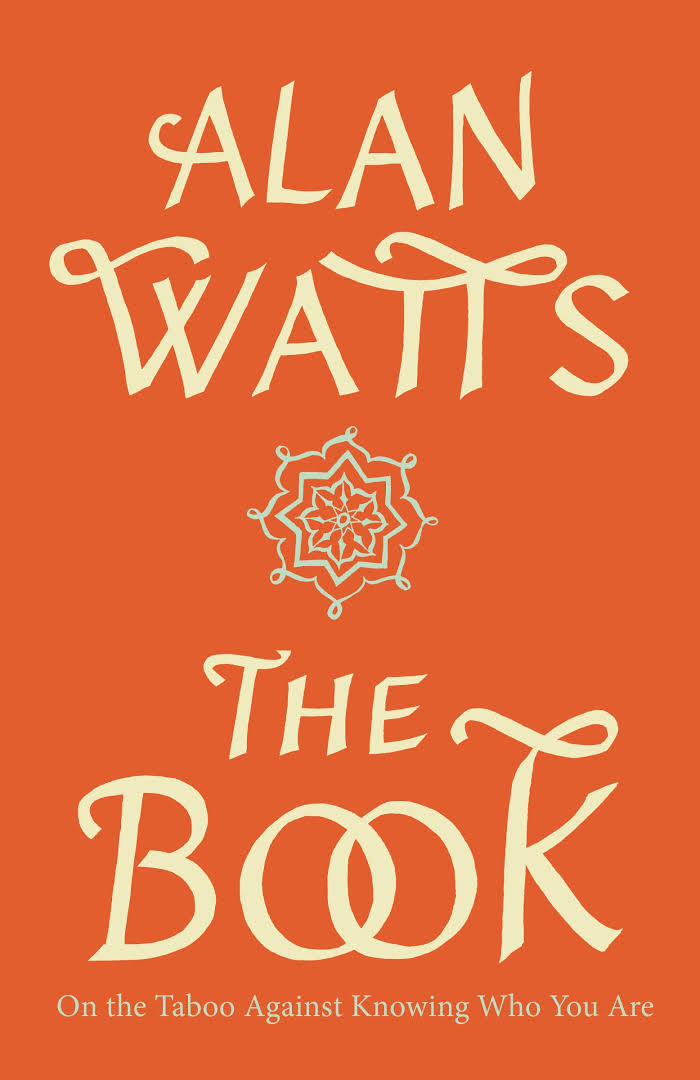
The Book
On the Taboo Against Knowning Who You Are
What, then, would be The Book which fathers might slip to their sons and mothers to their daughters, without ever admitting it openly?
Alan Watts (1915-1973) was a British philosopher who spent his career translating Zen and Vedanta for a Western audience. Published in 1966, The Book argues that the separate, isolated ego is a social convention, not a biological fact — something society teaches a child to feel long before the child can question it. Watts spends the book taking that convention apart and pointing at what’s left underneath: a self that isn’t cut off from the world but is the world, temporarily looking at itself through a pair of eyes.
A few lines worth keeping:
What, then, would be The Book which fathers might slip to their sons and mothers to their daughters, without ever admitting it openly?
We do not come into this world. We come out of it. As leaves from a tree. As the ocean waves. The universe peoples.
Our society—that is, we ourselves, all of us—is defining the individual with a double-bind, commanding him to be free and separate from the world, which he is not, for otherwise the command would not work.
He is being told that he must be free. An irresistible pressure is being put on him to make him believe that no such pressure exists. The community of which he is necessarily a dependent member defines him as an independent member.
The hallucination of separateness prevents one from seeing that to cherish the ego is to cherish misery. We do not realize that our so-called love and concern for the individual is simply the other face of our own fear of death or rejection. In his exaggerated valuation of separate identity, the personal ego is sawing off the branch on which he is sitting, and then getting more and more anxious about the coming crash!
Westerners locate the ego in the head, from which center the rest of us dangles. The ego is somewhere behind the eyes and between the ears. It is as if there sat beneath the dome of the skull a controlling officer who wears earphones wired to the ears, and watches a television screen wired to the eyes.
There is no point whatever in making plans for a future which you will never be able to enjoy. When your plans mature, you will still be living for some other future beyond. You will never, never be able to sit back with full contentment and say, “Now, I’ve arrived!”
Society, as we now have it, pulled this trick on every child from earliest infancy. In the first place, the child is taught that he is responsible, that he is a free agent, an independent origin of thoughts and actions—a sort of miniature First Cause. He accepts this make-believe for the very reason that it is not true.
Appears in think → forward