
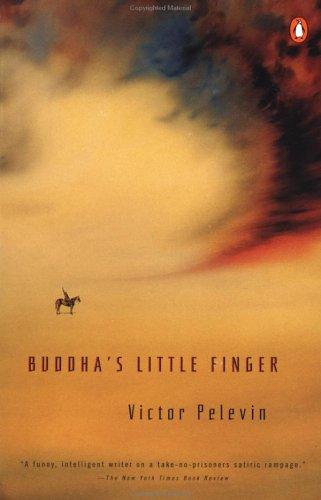
Buddha's Little Finger
Victor Pelevin (Чапаев и Пустота)
A Buddhist novel disguised as a civil-war fever dream. The emptiness at the bottom of the soul turns out to be the place the world is born from — every second.
Victor Pelevin’s third novel, written in 1996. The narrator, poet Pyotr Pustota (“Pyotr Void”), lives in two timelines at once — revolutionary Russia in 1918, where he becomes a Red Army commissar under the command of a mystical Chapaev, and a 1990s Moscow psychiatric ward, where he’s a patient being treated for exactly this delusion. Pelevin called it “the first work of world literature set in absolute emptiness” — a novel about Buddhist non-self staged as a fever dream of Russian history.
A few lines worth keeping:
Don’t stuff your head with what has no relation to the present.
At the bottom of the soul gapes the same emptiness — and it is from this emptiness that the world arises, arises every second.
A man is somewhat like this train. He is likewise condemned to drag behind him forever, out of the past, a chain of dark, frightening carriages he inherited from who knows whom. And he calls the meaningless clatter of this random coupling of hopes, opinions and fears his life. There’s no way to escape this fate.
With age I came to understand that the words “to come to yourself” actually mean “to come to others,” because it is these others who, from birth, explain to you what effort you must make on yourself in order to take the form pleasing to them.
The only path to immortality for a drop of wax is to stop thinking of itself as a drop and understand that it is the wax. But since our drop is only capable of noticing its own shape, it spends its whole short life praying to the Lord Wax for the salvation of that shape — even though the shape, if you think about it, has nothing to do with it at all.
Fear always attracts exactly what you’re afraid of. But if you’re afraid of nothing, you become invisible. The best disguise is indifference.
All these constructions exist only so that we can get rid of them for good. Wherever you end up, live by the laws of the world you’re in, and use those very laws to free yourself from them.
Appears in think → forward