
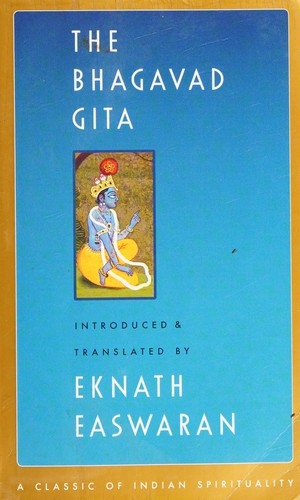
Bhagavad Gita
The Song of God
A warrior freezes before battle, and God — driving his chariot — explains how to act without being owned by the results. Three thousand years old and still the shortest complete manual.
The Bhagavad Gita is part of the Mahabharata epic — a dialogue between the warrior Arjuna and his charioteer Krishna on the eve of a battle. About 700 Sanskrit verses, dated roughly between the 2nd century BCE and the 2nd century CE. It’s one of the central texts of Hindu philosophy, built around duty, action without attachment to outcome, and the nature of the self.
A few lines worth keeping:
Free from attachment, fear and anger — he is not stained by the results of his actions.
Meeting the pleasant, he does not rejoice; meeting the unpleasant, he is not shaken.
Do what you must do — that is better than doing nothing.
The ignorant act for the sake of the fruit of their actions; let the wise act without thought of the fruit, for the good of the whole world.
What does not exist will never come to exist; what exists has always existed. So say those who have known the deepest truth.
Whatever the best man does, the rest follow; whatever he sets as the standard, the world pursues.
The more fully a person surrenders to Me, the more he receives from Me — whatever path he chooses, it will be My path.
Anger breeds a distorted reading of what is happening; then a person forgets how things really were, mistakes what he has invented for objective truth, and loses his reason. And that is what brings the fall.
Whatever a person is thinking of in the last moments in the body, that is what he becomes after leaving it.
Appears in think → forward