
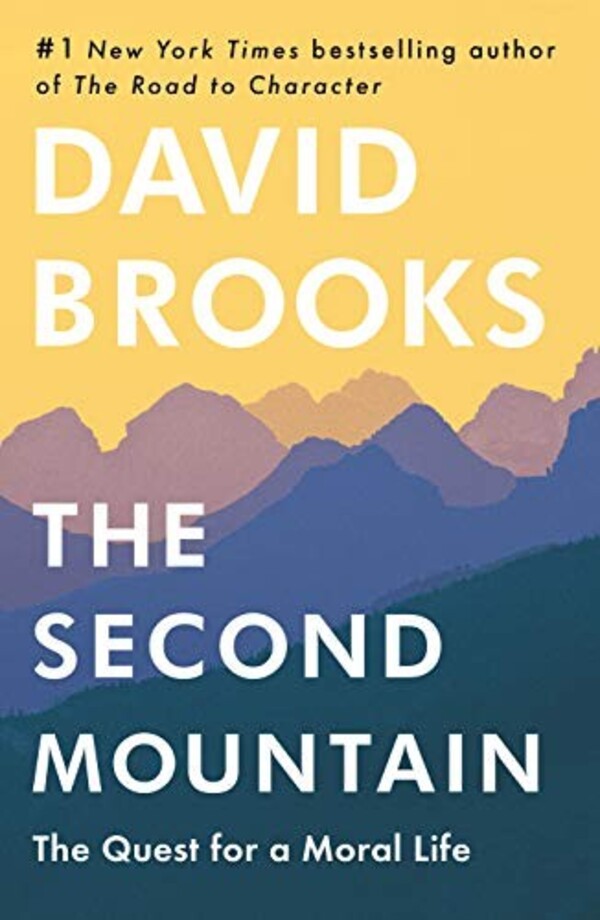
The Second Mountain
The Quest for a Moral Life
Happiness is good, but joy is better. The first mountain is about building the self; the second is about giving it away — and the deeper, more selfless life you commit to there is where lasting joy lives.
David Brooks is a New York Times columnist who wrote this 2019 book after his own first marriage and career-defined identity fell apart. He argues that a self built purely on individual achievement — the “first mountain” — eventually hits a wall, and that a second, more committed life becomes possible only after a season of suffering strips that self down.
A few lines worth keeping:
My core point is that happiness is good, but joy is better.
Freedom isn’t an ocean you want to spend your life in. Freedom is a river you want to get across so you can plant yourself on the other side—and fully commit to something.
When you ask people what experience made them the person they are, they never say, “I really was a shallow and selfish jerk until I went on that amazing vacation in Hawaii.” No, people usually talk about moments of difficulty, struggle.
The paradox of life is that people seem to deliberate more carefully over the little choices than the big ones. They slide incrementally into a career because someone gave them a job. They marry the person whom they happen to be living with.
Seeing well is not natural. It is an act of humility. It means getting your own self—your own needs and wishes—out of the way, so that you can see the thing you’re looking at as itself, and not just as a mirror of your own interests.
There’s always something flowing out of the interiority of our spirit. For some people it’s mostly fear or insecurity. For the people we call joyful, it’s mostly gratitude, delight, and kindness.
Acedia is the quieting of passion. It is a lack of care. It is living a life that doesn’t arouse your strong passions and therefore instills a sluggishness of the soul, like an oven set on warm.
The odd thing about the soul is that while it is powerful and resilient, it is also reclusive. You can go years without really feeling the force of its yearning. You are enjoying the pleasures of life, building your career. It’s amazing how untroubled you can be, year after year, while your soul is out there somewhere far away. But eventually it hunts you down.
In the valley, if you are fortunate, you learn to see yourself as a whole person. You learn you are not just a brain and a set of talents to impress the world, but a heart and soul—primarily heart and soul.
Connection happens at the nexus of truth and love. Truth without love is harshness. Love without truth is sentimentality. But if you can be completely honest with somebody in the context of loving support, then you have a trusting relationship.
Second love is the kind of love people have for each other after they’ve seen each other at their worst, after they’ve forgiven a few times and been forgiven, after they can take some pride in having survived together.
Enchanted lovers crystallize each other in this way, their adoring eyes scattering diamonds on every virtue of the beloved. The more they idealize each other at this phase, the more lasting their marriage is likely to be in the decades to come.
Appears in think → forward