
The only meaning
People spend their whole lives hunting for the meaning of life, as if it were buried somewhere, heavy and serious, waiting to be dug up.
It isn’t. The only meaning of life is to be joyful while we’re here. That’s the whole thing. Everyone keeps looking for something heavier and walks right past it.
The purpose of life is to be happy. — Dalai Lama
You don’t earn the right to enjoy life once the work is done. The enjoying is the work. You’re here for a blink, a few spins around the sun and you’re gone, and the only thing to do with that blink is fill it with what you love. You don’t work music, you play it, and the point isn’t to reach the last note faster. Same with life: it’s for living, not for worrying, not for racing to retirement.
I used to think this was naive. Then I started paying attention and saw that everyone who ever looked clearly arrived at the same simple place. The meaning is to gather as much magic as you can. How? Widen the patch of joy in your brain, clear the junk out of your life, do what’s interesting.
So don’t take any of it too seriously. The party’s short. Find what’s fun and do that. That’s the meaning.
It’s all the same
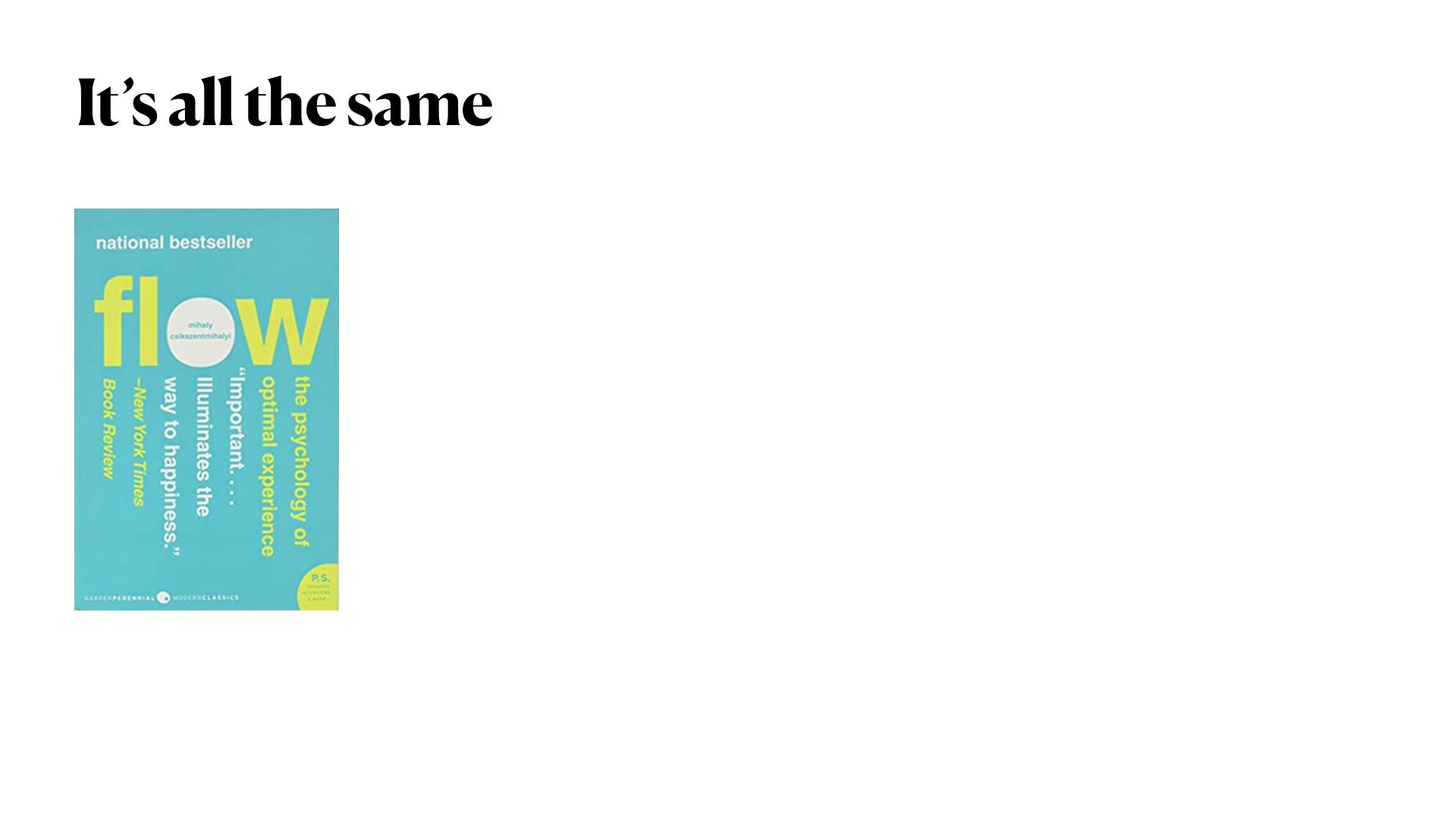
Once you clear the noise, you start to see it: all the books, all the philosophies are about the same thing.
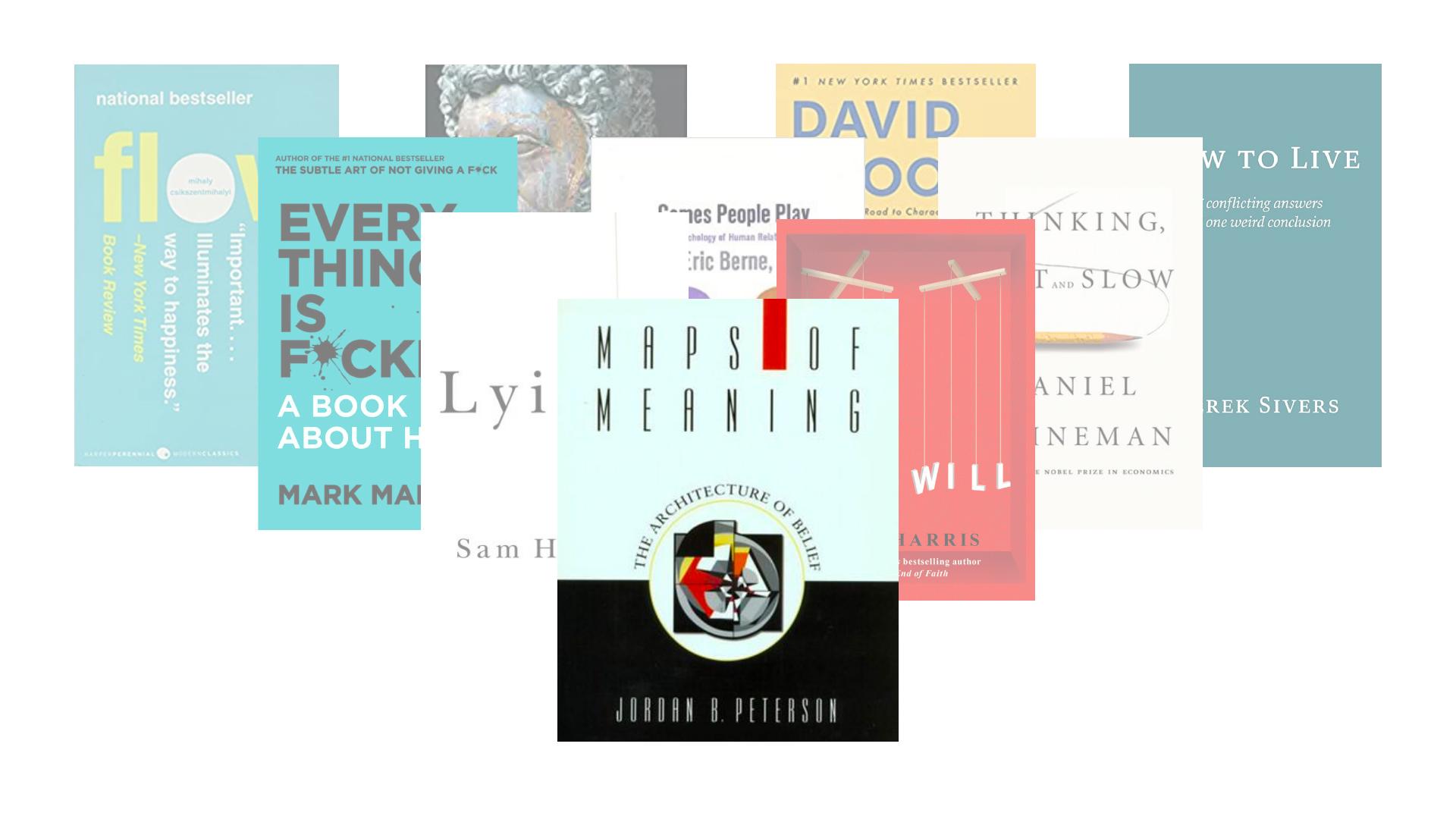
Flow. Marcus Aurelius. The Second Mountain. Everything Is F*cked. Games People Play. Thinking, Fast and Slow. Free Will. Maps of Meaning. Stack them up and they all point the same way.
Read slowly. Flow is nirvana. Stoicism is the eightfold path. The Second Mountain is intentional living. How to Live is Zen and Daoist koans. And karma isn’t fate: karma means doing.
I want more, and I’m already content.
That’s Stoicism and the eightfold path in one breath.
Even Stoicism is Buddhism with overcoming bolted on. The Stoics tell you to grit your teeth, master yourself, push the negative out by force of will. Buddhism cuts the overcoming out.
Buddhism just says it straight: it’s all inside you. Sit and watch. See what’s tormenting you, and let it go.
Because there’s nothing to overcome. Nothing to fight. Just stop dragging the weight of the past around. Put the suitcase down. You never had to carry it up the mountain, only to climb.
Ikigai
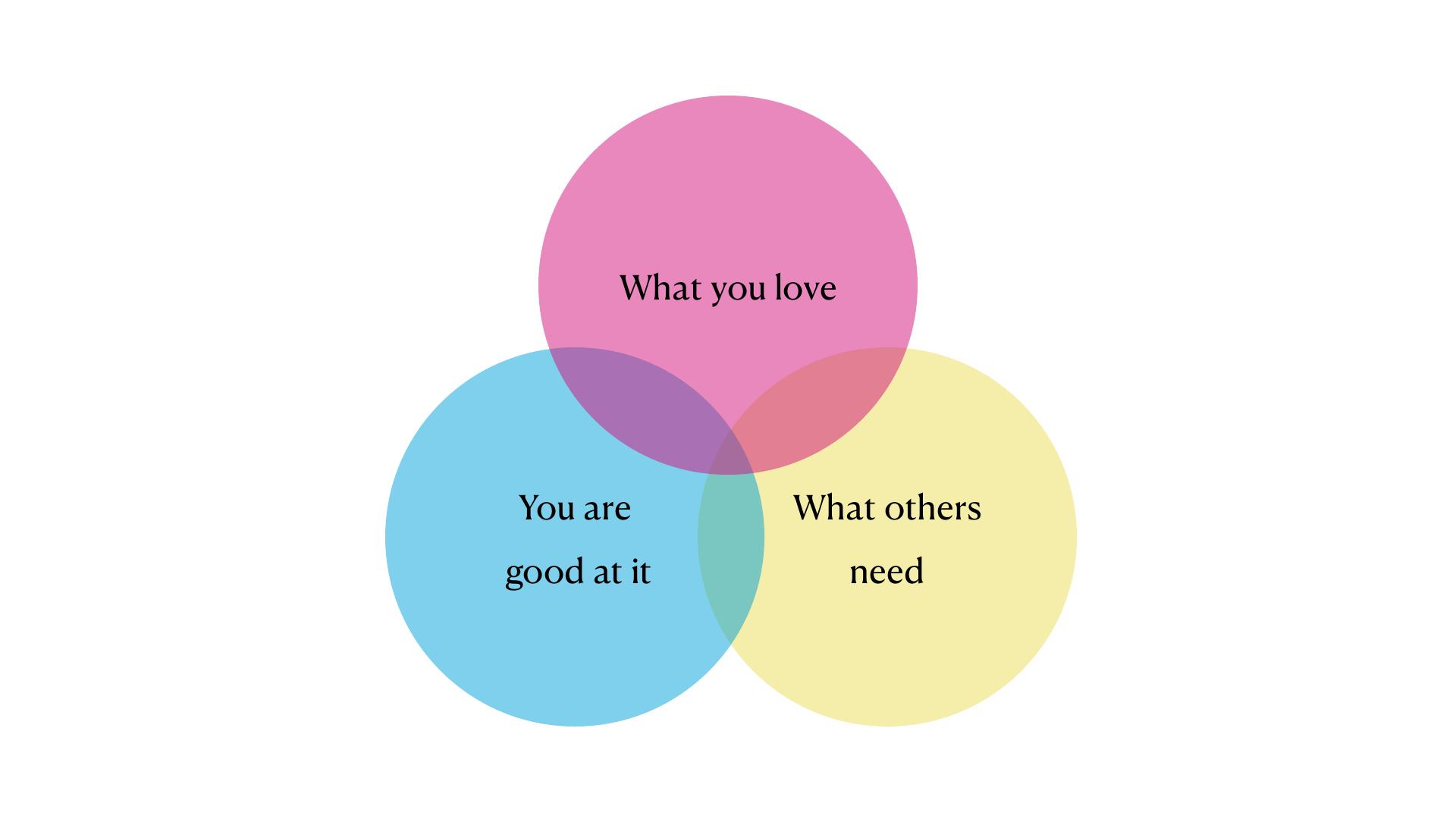
This one comes from Japan: ikigai, a reason for being. The same idea, aimed at the question of what to actually do with your life.
Three circles: what you love, what you’re good at and what others need. Where all three overlap, that’s it. The place where what you love and what you’re good at turns out to be exactly what others need.
You’ve probably seen the four-circle version, the career-slide mandala with “what you can be paid for” drawn in as a fourth petal. A British blogger put it together in 2014 by pasting the word ikigai onto someone else’s diagram. In Japan, ikigai is what gets you up in the morning, and money has nothing to do with it. Erase that circle. Get the first three right and money arrives on its own schedule, as a side effect.
You already half-know where yours is. It’s usually the thing you’d keep doing even if no one paid you.
So why aren’t you doing it? Research, usually. You open the laptop to check whether your thing is viable, find a thousand people already doing it, and quietly put it back on the shelf. That check is the trap. Any field can feed you; the variable is the person building it. The market never rejected your thing. You did, on its behalf.
Here’s what the diagram never shows: the overlap grows. You pick your thing and feed it a little every day. A fraction of a percent a day looks like nothing; for months the curve lies flat and you doubt everything. Around day ninety you look back and you’re somewhere else. Give it four years. That’s roughly how long something you love takes to start feeding you back. A degree takes the same four years and ends in debt; this one ends in a life.
You’ll know the right circle by feel: on those days the wave carries you, and you stop paddling.
Do what you like. No, like harder.
Somewhere inside those four years the strangest dividend arrives: the one who crosses the finish is someone new. And that someone showed up while you were still alive. Rebirth, it turns out, doesn’t wait for death.
The Reading List
Dance First. Think Later.
618 Rules to Live By
Six hundred eighteen one-line answers to ‘how to live’ — collected from people who actually lived. Open anywhere; the title rule alone is worth the book.
Flow
The Psychology of Optimal Experience
The best moments of our lives come not from passive comfort but from being fully absorbed in a challenge that stretches us — flow. Happiness isn’t found by chasing it; it’s the byproduct of total engagement in what we’re doing.
Meditations
The Private Notebook of a Roman Emperor
You don’t control what happens — only how you meet it. The obstacle is the way, the present is all you ever hold, and a good life is simply the steady practice of reason, justice, and acceptance.
The Second Mountain
The Quest for a Moral Life
Happiness is good, but joy is better. The first mountain is about building the self; the second is about giving it away — and the deeper, more selfless life you commit to there is where lasting joy lives.
How to Live
27 conflicting answers and one weird conclusion
Twenty-seven directives for how to live, each chapter arguing the opposite of the last — all true, all incompatible. The weird conclusion: there’s no single right way, so pick a stance fully and live it.
Games People Play
The Psychology of Human Relationships
Much of what passes for relationship is a set of repeating, ulterior transactions with a hidden payoff — games we run on autopilot. See the game, and you get the choice to stop playing and meet people for real.
Thinking, Fast and Slow
How two systems of thought shape every judgment we make
The mind runs on two systems — a fast, intuitive one that jumps to conclusions, and a slow, deliberate one that does the hard work. Most of our errors come from trusting the fast one when we should slow down.
Free Will
Why the Author of Your Thoughts Is Not You
Free will is not just an illusion but a conceptually incoherent idea — your thoughts and actions arise from causes you neither chose nor control. Seeing this clearly doesn’t make you fatalistic; it makes you more compassionate, more honest, and paradoxically more free.
Maps of Meaning
The Architecture of Belief
The myths and stories every culture tells aren’t naive science — they’re maps of how to act in a world we can never fully know. Meaning lives on the line between order and chaos, and the way through is to face what you most want to avoid.
Lying
Why Honesty Is the Shortcut to a Simpler Life
Lying — even the small, kind, socially convenient kind — quietly complicates your life and weakens your relationships. Commit to telling the truth, and the people and problems that matter rise to the surface on their own.
Everything Is F*cked
A Book About Hope
Hope isn’t optimism — it’s the refusal to give up on a future worth wanting. We don’t need more freedom or comfort; we need something bigger than ourselves to give a f*ck about.