
The movie in your head
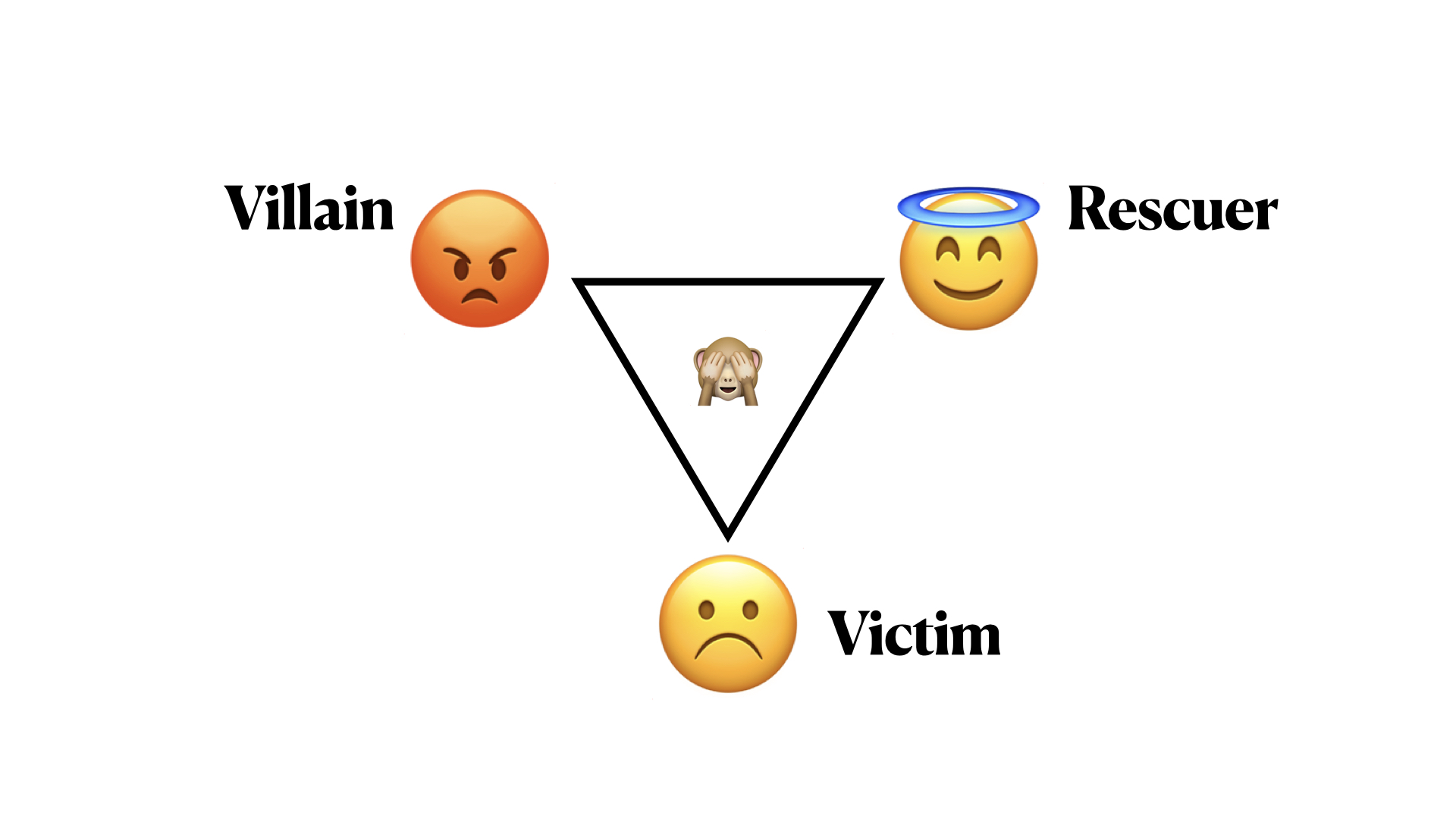
There’s a trap with three seats: the Victim, the Persecutor and the Rescuer. Karpman drew it as a triangle, and the triangle keeps pulling more people in.
The Victim feels oppressed, helpless or in some kind of distress, and looks for sympathy and support. That’s how others get pulled in. The Persecutor criticizes, blames or attacks the Victim and can come across as aggressive or domineering. The Rescuer tries to help the Victim or shield them from the Persecutor. Or only thinks so: often the Rescuer helps to feel needed, or to feel above everyone else.
The dynamic runs in circles, and people switch roles. A Victim can become a Persecutor or a Rescuer when the situation changes.
Recognize the pattern. It leads to unhealthy relationships. As usual, telling the truth helps.
You cannot continue to victimize someone else just because you yourself were a victim once—there has to be a limit
Edward Said
Avoid the Drama Triangle at all costs. Don’t play any of the three roles.
You can only help those who are doing something. But first of all, help yourself.
The triangle is a film that plays in your head: the mind casts the roles, then takes a seat to watch.
The projector
Between you and the world there’s a layer. Every face, every event, every word passes through it before it reaches you. You can catch it in the act: look at a stranger and notice how much you “see”: age, mood, intentions, a whole life story read off a walk. You’re filling it in.
For years I assumed the matrix was somewhere out there. Only later did it click: the matrix is in your head.
Your beliefs draw the world nonstop, like a picture thrown by a projector. Problems, situations, events all play from the inside. It’s a film you’re so absorbed in that you forget you’re watching one.
Each of us gets our own soap bubble of reality. A private hallucination. We all imagine something similar, each in our own way. The real world can’t be known: we see it through a 3D headset that never comes off. We’re limited to what the nervous system draws.
The practical upshot sounds too simple. If the world you live in is a projection, you can retune it. Just by thinking about things differently. I tested it for years. You simply start having a good time, all the time.
That’s the whole of esoterics: see that you live inside your ideas about the world, and retune them.
How deep does the projection go? All the way down.
The interface
Australia nearly lost a whole species of beetle to beer bottles. The males abandoned living females and courted empties tossed by the road: the bottles were browner, shinier, more “female” than any female alive. To save the species, the bottle had to be redesigned.
Funny. Right up until you ask what our bottles are.
Donald Hoffman, a cognitive scientist, asked exactly that: does evolution favor creatures that see reality as it is? The math said no. A colleague of his proved a theorem: an organism that sees the truth will never outcompete an organism of the same complexity that sees only what helps it survive. In simulation after simulation, the truth-seers go extinct. Every time. The beetles weren’t seeing a bottle or a female. They were seeing a fitness score. So are we.
Look at a file icon on your desktop. The file isn’t blue, and it isn’t rectangular. The icon hides the transistors and the voltages; that’s what it’s for. You drag the file to the trash knowing nothing about electrons. Hoffman’s claim: space is your desktop, and every object in it, stars, cars, people, is an icon. Useful for survival. Silent about what’s underneath.
Lately he puts it in VR terms: the body is an avatar. You chase a red Corvette in a racing game, and inside the computer there’s no Corvette, only bits flipping at insane speed. “The probability that I see a rock because a rock is really there? Exactly zero percent.” And when physicists report that space-time breaks down at the deepest scales, and that particle collisions can be predicted with no space and no time at all, he shrugs: the headset was never reality.
Plato said we watch shadows on a cave wall. Vedanta called it maya. Kant said the thing-in-itself is out of reach. The idea is ancient. The theorem is new.
Which leaves one question: if everything you perceive is a screen, who’s watching it?
The observer
Try to catch him. Sit still for ten minutes and watch your thoughts. Two strange things will show up. First, you’re not thinking the thoughts: they arrive on their own, uninvited. Second, and stranger: someone notices them arrive.
That second one is the discovery. There’s the you that shows up inside the thoughts, worrying, planning, replaying yesterday. And there’s the you that watches the thoughts appear. Two different yous. Every meditation tradition circles this fork. In India they call it the witness. Jung called it the self watching the ego. Just call it the observer.
Once, during practice, it happened to me all at once: I stepped out and caught that I wasn’t there. Just the camera, moving. No thoughts. No body.
The observer is the point thoughts are seen from. And attention, the beam it looks with, can be trained. Turn attention from a function into a substance: it thickens, builds up, gains density like a muscle under load.
So what do you do with the ego, the loud character in the middle of the film? In spiritual circles the custom is to give it up. Notice who grips that idea hardest: usually people whose ego was weak to begin with. The ego is something to outgrow. Throw it away and there’s nothing left to grow from. It’s manure; growth feeds on it.
The whole practice fits in two words: just watch. Watch, and don’t invent meanings for what you see. The film keeps running, the projector keeps humming, but now you know where you’re sitting. Behind the lens.
And the observer grows. There are maps of how far.
The Reading List
The Game of Life and How to Play It
Florence Scovel Shinn, 1925
A century-old manual for the projector: whatever you speak and expect, the world develops into film. Naive on the surface, precise in the mechanics — fear is just faith pointed the wrong way.