
How did we get here?
Compress the history of Earth into a single day, and each second covers 52,000 years. Dinosaurs show up at 22:46 and last 52 minutes. Humans, Homo sapiens, arrive six seconds before midnight. The last ice age ends two-tenths of a second before midnight, and Earth settles into the conditions we know today. The first pyramid in Egypt goes up nine-hundredths of a second before midnight. All of civilization fits into the last tenth of a second.
And we just got here.
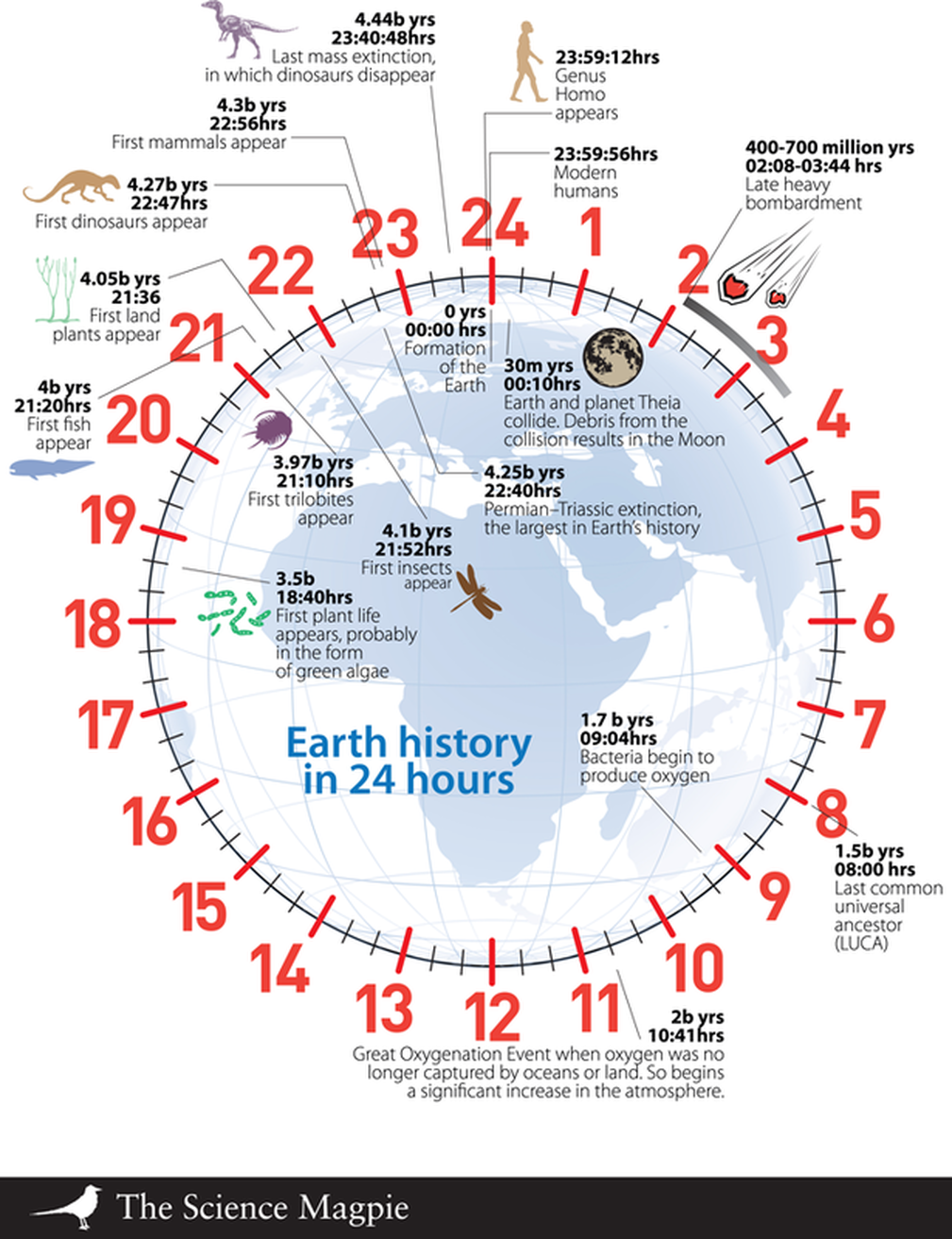
Earth forms at midnight. At 05:20 the first life appears: prokaryotes. At 08:00 the first organisms learn photosynthesis, and by 11:12 the atmosphere fills with oxygen. Complex cells, the eukaryotes, show up at 13:20, multicellular life at 18:40, the first animals at 20:48. At 21:07 the seas burst with new forms in the Cambrian explosion, and at 21:30 plants crawl onto land. The dinosaurs die out at 23:39. Early human ancestors appear at 23:58.
A young science
Psychology, the science of us, is only about a century and a half old. Science usually starts with whatever is easiest to reach and slowly digs deeper. So at first psychology studied only what went wrong. Thank God, it grew into positive psychology, which isn’t even thirty years old. Just as physics has almost discovered God, psychology has reached him through the mind.
The tree of life
Look at this beautiful chart. There is also an interactive version.
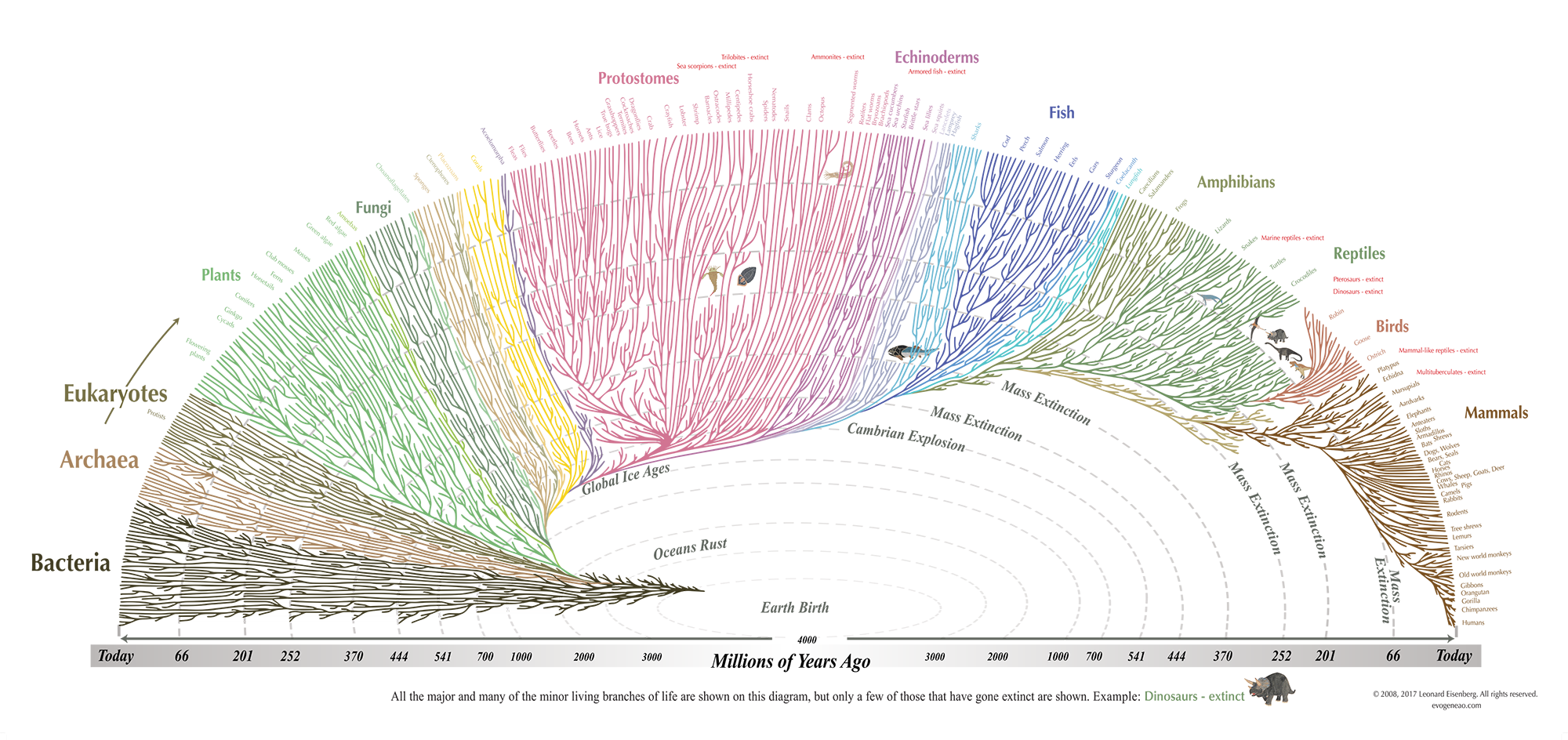
Life on Earth is one big extended family! Every human being is related genealogically not just to all other humans, but to all other living things. And not only organisms living today, but to everything that has ever lived.
— Evogeneao, Tree of Life
We don’t just have common ancestors. We’re more closely related than you’d think. The same goes for the brain: shared structures, shared behaviors.
A newborn already knows its mother’s voice — it has been hearing it from the inside. Its brain is the size of an adult chimpanzee’s, and that’s only a quarter of what it will grow into. Life builds the rest.
But one thing was there from the very start. Love of life.
All is full of love
We inherit more than just nervous tissue. From bacteria to humans, every living thing shares one thing — the love for life.
A single-celled organism seeks food. A plant reaches for sunlight. No one taught them. It’s built in. This drive to live needs no explanation. It’s the reactor that powers our lives.
Twist your head around
It’s all around you
All is full of love
All around you
Look at children — happy, curious. When the little ones, both human and animal, are fed and rested, they want to play and explore. Rats laugh when you tickle them. The sound is ultrasonic, too high for human ears, but instruments pick it up. A rat that’s been tickled comes running back to the hand.
Somewhere along the way, this light starts to dim. This is why I am writing these words. It’s always easier to prevent.
Once you notice this spark, you can keep it burning. Everything else is built on top of it.
There is no point in suffering all the time. A snailfish has been filmed more than eight kilometers down, where the pressure is eight hundred times higher than at the surface. Bacteria live in scalding water around hot vents on the ocean floor, at 122 degrees Celsius. It doesn’t seem to bother them. They just live. This force drives everything.
How does the love for life move through the brain? In layers.