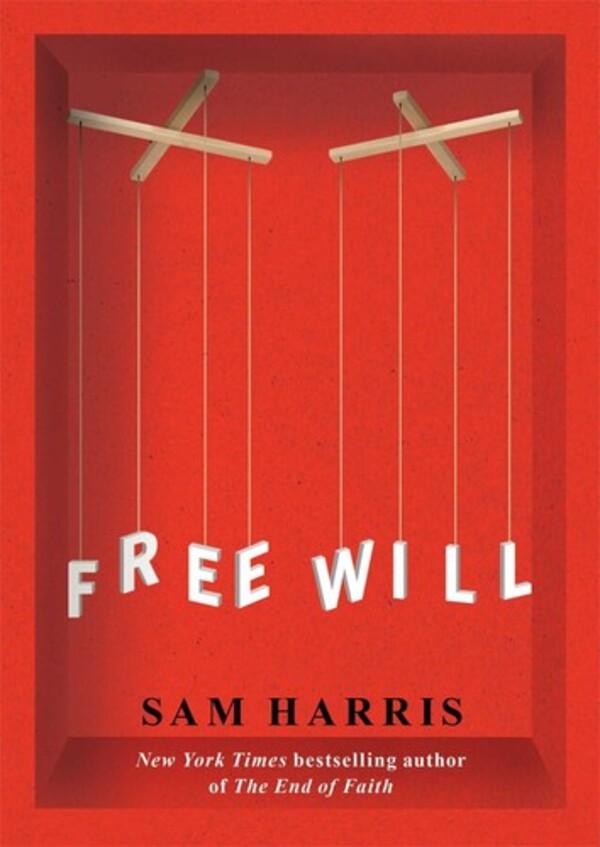
Free Will
Why the Author of Your Thoughts Is Not You
Free will is not just an illusion but a conceptually incoherent idea — your thoughts and actions arise from causes you neither chose nor control. Seeing this clearly doesn’t make you fatalistic; it makes you more compassionate, more honest, and paradoxically more free.
Sam Harris is a neuroscientist and philosopher. Published in 2012, this short book makes a tightly argued case, drawing on neuroscience (Libet’s experiments, fMRI studies that predict decisions seconds before we’re aware of making them) and plain introspection, that the felt sense of authoring our own thoughts doesn’t survive close attention — and that losing it changes ethics and justice for the better, not the worse.
A few lines worth keeping:
Free will is an illusion. Our wills are simply not of our own making. Thoughts and intentions emerge from background causes of which we are unaware and over which we exert no conscious control.
You are not controlling the storm, and you are not lost in it. You are the storm.
A puppet is free as long as he loves his strings.
You can do what you decide to do — but you cannot decide what you will decide to do.
Losing a belief in free will has not made me fatalistic — in fact, it has increased my feelings of freedom.
The illusion of free will is itself an illusion.
You are not in control of your mind — because you, as a conscious agent, are only part of your mind, living at the mercy of other parts.
Willpower is itself a biological phenomenon. You can change your life, and yourself, through effort and discipline — but you have whatever capacity for effort and discipline you have in this moment, and not a scintilla more.
You have not built your mind. And in moments in which you seem to build it — when you make an effort to change yourself, to acquire knowledge, or to perfect a skill — the only tools at your disposal are those that you have inherited from moments past.
The urge for retribution depends upon our not seeing the underlying causes of human behavior.
Laziness, like diligence, is a neurological condition.
Appears in think → forward