
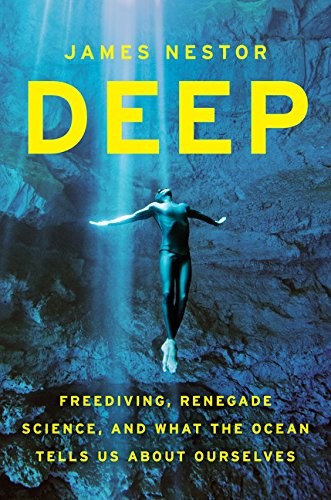
Deep
Freediving, Renegade Science, and What the Ocean Tells Us About Ourselves
A journalist follows freedivers down and finds a doorway: the deeper the body goes, the quieter the mind gets. The ocean as a laboratory of consciousness.
James Nestor is a journalist who spent years reporting on freediving and marine science for this 2014 book. He follows self-taught divers, biologists, and world-record holders into open water to study what extreme depth does to the human body and mind — and what it reveals about instincts we still carry from an aquatic past.
A few lines worth keeping:
It’s easy. You just take a breath and go.
It offers a stillness — a kind of full-body meditation that could be found nowhere else.
Those who’d reached the doorway described it in quasireligious terms — transcendent, life-changing, purifying.
An infant will reflexively breaststroke when placed underwater and can comfortably hold his breath for about forty seconds, longer than many adults. We lose this ability only when we learn how to walk.
By stripping off all the gear — the tanks, weights, regulators, and buoyancy-control devices — divers could dive deeper, more often, and four times as fast as someone wrapped in the most technologically advanced equipment.
At 250 feet, the pressure is so extreme that your lungs shrink to the size of fists and your heart beats at less than half its normal rate to conserve oxygen. Heart rates of freedivers at this depth have been recorded as low as fourteen beats per minute.
“Do I look like some adrenaline junkie? Freediving with sharks is the opposite of an adrenaline sport. You need to be calm, balanced. You need to know yourself. Being relaxed and in control is the only way you can do it.”
Freediving is more than just holding your breath, it’s a perception shift.
This was a spiritual practice, a way of using the human body as a vessel to explore the wonders in the Earth’s inner space.
Appears in think → forward